Your menu, your online ordering — pickup, delivery, a table order, or a treat bought for another table — paid by card straight into your own Stripe account. Reservations and a live table board out front; pantry, food cost and the schedule behind the pass. No commission on a single ticket.
One owner-operator and a small group with catering on the side need the same menu, the same cart and the same schedule — so it is one site type, not two products.
You own a single restaurant — a dining room, a counter, or both. You cook, you run the floor some nights, and the website is whatever somebody built you three years ago.
Your menu, your ordering and your reservations on your own site and your own Stripe account — and a pantry and food-cost view behind it so pricing is a number, not a guess.
You run two or three rooms — or one room plus the events and trays that pay for the slow weeks — and you are the person who ends up holding every schedule and every order.
One console for the room: menu, orders, tables, pantry, schedule and tip pooling — with catering arriving as an enquiry today and bookable quotes on the roadmap.
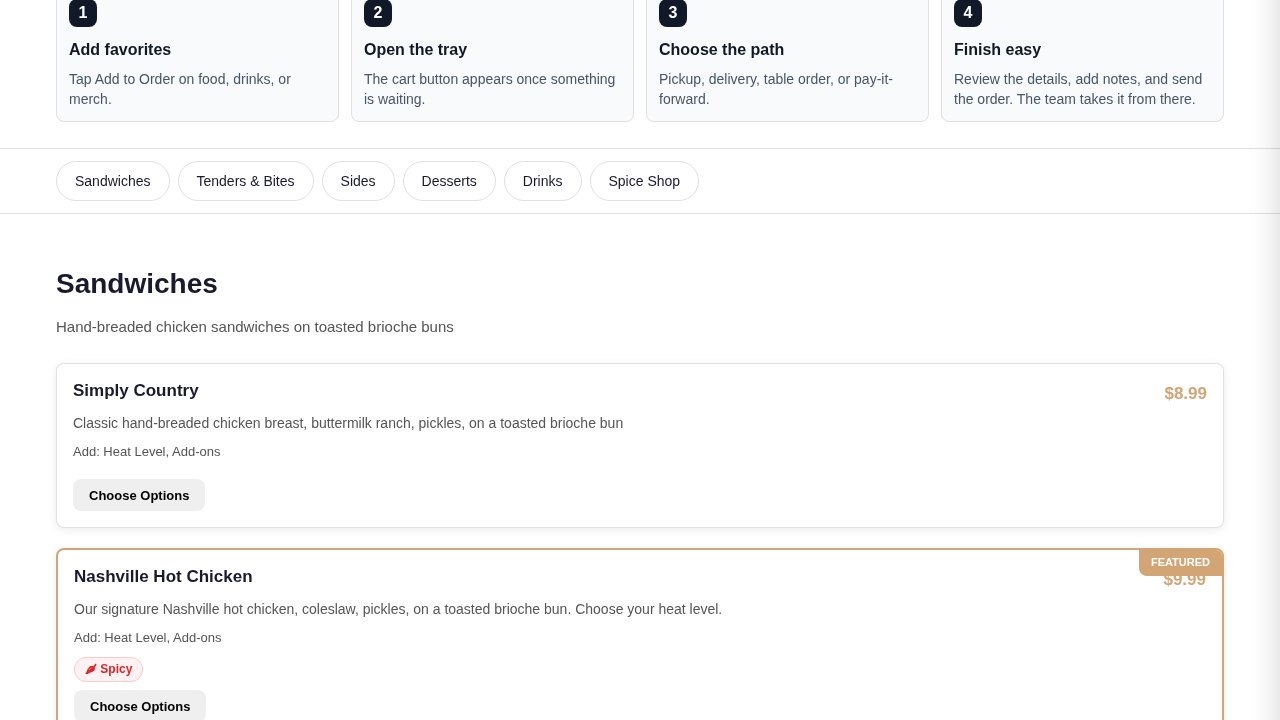
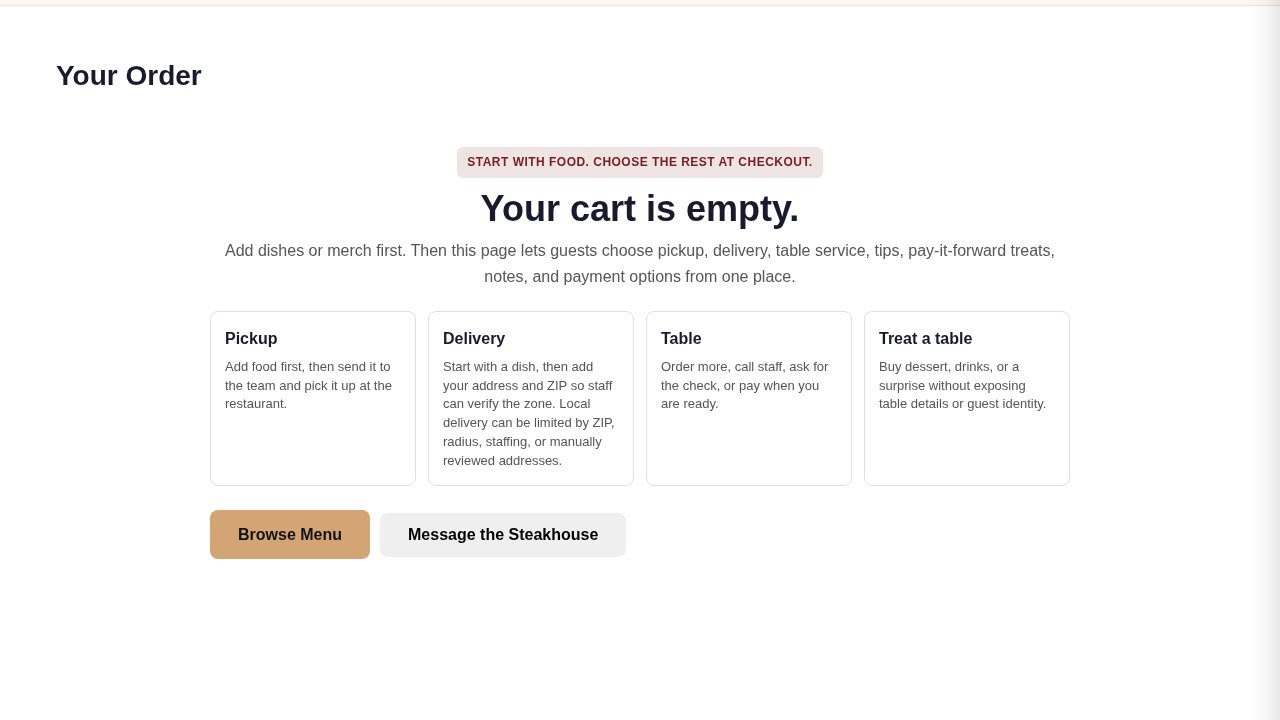
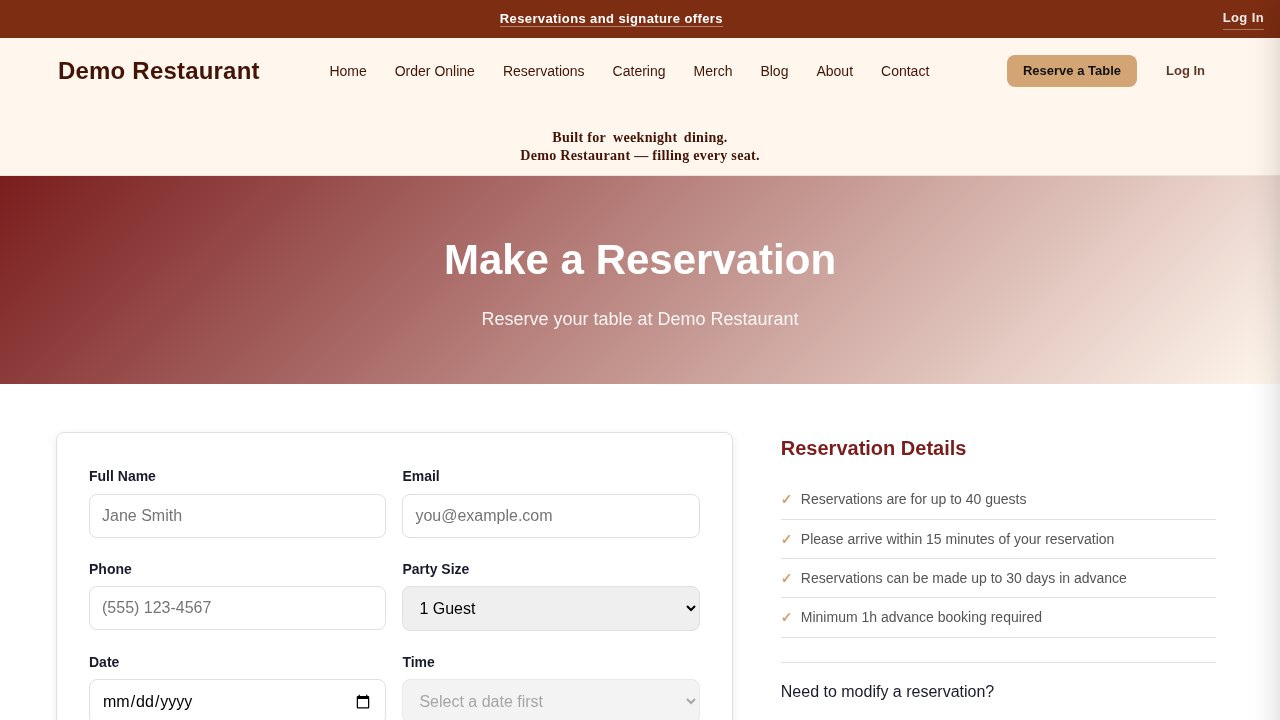
Three pages from a live restaurant site running on this platform, exactly as a guest sees them.

Categories across the top, dishes with descriptions and prices, add-ons and heat levels behind Choose Options, and a Featured badge on the one you want ordered.

Pickup, delivery inside your own ZIP zone, a dine-in order sent from the table, or a pay-it-forward treat bought for someone else's table — all from the same cart.

Party size, date and the time slots you actually have — with your maximum party, your advance notice and how far ahead you'll book stated right beside the form.
Everything marked now is running on the demo you can click through above. Anything marked coming is on the roadmap and not something you should count on yet.
Categories, dishes, descriptions, prices and photos, with option groups and add-ons behind each item, featured dishes, and allergen and dietary disclosures kept beside the food they belong to.
A guest adds food, then picks the path at checkout: pickup, delivery, a dine-in order from the table, or a pay-it-forward treat for another table. One cart, one flow, no second app.
Guests pay you, through your own Stripe account, on your own site. There is no platform commission on any ticket — the subscription is the whole bill.
Accept delivery only for the ZIP codes you allow. An address outside the zone is turned down at checkout with an explanation, instead of at the door forty minutes later.
Guests book by party size, date and an actual open slot — built from your maximum party, your minimum advance notice and how far ahead you take bookings. Confirm or decline from the admin.
Tables, table sessions and table status in one board, plus guest requests sent from the table, so the room knows what is seated, what is waiting and what needs running.
Set your combined rate once and it is applied to the food on every online order and shown to the guest before they pay, alongside your service charge and their tip.
Kitchen inventory by zone, prep recipes built from it, a reorder list when stock runs down, and a cost rollup that puts a real food-cost percentage beside each menu price.
Build the schedule, track shifts and time entries, and split pooled tips by the points you set — with a payroll summary you can hand to whoever runs payroll.
A guest reviews the item they actually ordered, and nothing publishes until you approve it — so the menu page carries real feedback rather than whatever the internet felt like saying.
Run a special, keep a guest profile with the birthday or anniversary a guest chose to give you, and follow up after the visit instead of hoping they come back.
Today the catering page states your headcount minimum and lead time and sends the enquiry to you. Quoting an event, taking a deposit and putting it on the calendar are on the roadmap.
Texas charges state sales tax on prepared food, and your local taxing jurisdictions can add their own on top — but only up to a fixed ceiling. Set your combined rate once and every online ticket computes it for you:
Alcohol is taxed on its own returns and is not calculated here. The Comptroller charges a mixed beverage permittee 6.7% mixed beverage gross receipts tax on alcohol sales, and a separate 8.25% mixed beverage sales tax on the drink itself. Set your food rate on this site and leave the bar's returns where your accountant already files them. Rates and rules: the Texas Comptroller, comptroller.texas.gov.
The signup wizard gets the site up. The parts that need your real numbers wait for the admin, where they can actually be applied.
Your name, your town and what kind of room it is. The site is built with a menu page, an ordering page, reservations, catering, merch, a blog and the usual about and contact pages already in place.
Categories first, then dishes with prices, descriptions and any option groups — heat levels, add-ons, sides. This is the part worth doing properly; everything else on the site points at it.
Your sales-tax rate, service charge, delivery ZIP zones, reservation limits and hours. The signup wizard does not ask for these because nothing would apply them yet.
Link your own Stripe account, put a test order through the cart end to end, and you are taking real ones.
I've spent 30-plus years in pest control, not in a kitchen. I built LuperIQ because the software small operators get stuck with is either bloated or an afterthought, and I figured a guy who wrote his own OS as a first Rust project could do better.
Restaurants run on the same engine as everything else here — a catalog, a cart, real card payments, bookings, staff scheduling, inventory. What the restaurant module adds is the part that is specific to a room: the four ways a ticket can be fulfilled, the table board, prep recipes and what a plate costs you.
I'd rather tell you what this is not. It is not a POS terminal, it does not dispatch drivers, and there is no points programme. It is your own website, your own ordering, your own reservations and the back-of-house numbers behind them — without a percentage coming off every ticket.
There is a live restaurant site on this exact platform — a real menu with option groups and prices, the four-path cart, a reservation form with working time slots, and the catering and merch pages that come with it. Browse the menu, open the cart, book a table.
Open the live restaurant demo →
No. You pay a flat subscription for the platform. Every order runs through your own Stripe account, your guests are your guests, and nothing is skimmed off a ticket — whether it is a $9 sandwich or a $400 table.
No, and it is worth being blunt about it. There is no terminal, no cash drawer, no card reader and no end-of-night close. This is your website, your online ordering, your reservations and the back-of-house numbers behind them. Whatever you ring the room up on stays where it is.
You can take delivery orders, and you control which ZIP codes are inside your zone — an address outside it is refused at checkout with a note to pick up instead. What the product does not do is dispatch: there is no driver app and no routing. Delivery is you, your staff, or whoever you already use.
A guest buys dessert, a drink or a surprise for another table — one they name, or one you pick. The recipient's table details and identity are never exposed to the buyer, and you can require the recipient to accept before it lands. It is opt-in per restaurant, off unless you turn it on.
You set one combined rate — 6.25% Texas state plus your local jurisdictions, up to the 8.25% ceiling — and it is applied to the food on every online ticket and shown before the guest pays. Alcohol is a separate matter: the mixed beverage taxes are filed on their own returns and this site does not calculate them.
Yes. They pick party size, date and a real open time slot, built from your maximum party size, your minimum advance notice and how far ahead you take bookings. You confirm or decline from the admin, and the floor sees it on the table board.
No. Keep whatever is already working. This is your own ordering channel sitting alongside it, on your own address and your own Stripe account, where nothing comes off the top. Most operators start by pointing regulars at it and leave the rest alone.
Not today, and the page will say so until there is. What exists is a guest profile — the birthday or anniversary a guest chose to hand you, and their order history — plus specials and post-visit follow-up. Points and rewards are not built.
About 15 minutes to answer the setup questions and connect Stripe. Loading the menu properly takes longer than everything else combined, and your tax rate, delivery zone and reservation rules are set right after, under Admin → Restaurant.
Restaurant runs on LuperIQ's Business plan — every module, every page type, unlocked from day one, whether it is one room or three.
One room or three — start free, load a few dishes, and put a real order through the cart before you decide.
Start Free — 7 Days, No Card